The image of a plainly dressed Victorian lady carrying a lantern is one that
comes to mind when one thinks of Florence Nightingale and it is universally
known that she was a nurse during the Crimean War, but there is much more to
Florence than that! Her drive and determination, her concern for the plight of
men whose deaths were not being brought about as a result of enemy action but by
neglect and ignorance, her persistence and her undying belief in her call from
God saved lives and revolutionised medical care and the nursing profession.
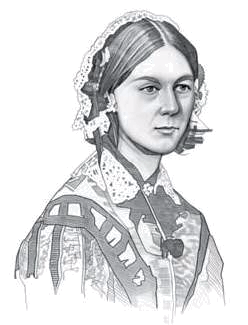 She was
born in Florence in the spring of 1820 and named after the city. Her father
William Nightingale was a wealthy landowner from Derbyshire. He was a man of
letters and tutored his daughters in modern languages , history and mathematics.
Both he and his wife Fanny led active social lives and in the general scheme of
things Florence, being intelligent and accomplished, would have been expected to
make a brilliant marriage. Florence had other ideas however. She was a devout
Christian and felt she wanted to spend her life as one of service to God.
She was
born in Florence in the spring of 1820 and named after the city. Her father
William Nightingale was a wealthy landowner from Derbyshire. He was a man of
letters and tutored his daughters in modern languages , history and mathematics.
Both he and his wife Fanny led active social lives and in the general scheme of
things Florence, being intelligent and accomplished, would have been expected to
make a brilliant marriage. Florence had other ideas however. She was a devout
Christian and felt she wanted to spend her life as one of service to God.
In her early twenties she decided to work as a hospital nurse. This decision
horrified her parents because at that time nursing was not viewed as at all
respectable and conditions in hospitals were terrible. Undeterred she managed to
visit some hospitals and eventually persuaded her parents to allow her to spend
a few months at a German training school for nurses and female teachers. She
also spent some time working in Paris which all helped to widen her experience.
She was obviously successful and in 1853 she became the superintendent of the
London charity-supported Institution for Sick Gentlewomen in Distressed
Circumstances.
1853 was the year of the outbreak of the Crimean War and it was one of the
first wars to be reported in the British press. The reports of vast numbers of
casualties who were dying through lack of medical treatment horrified the
British public. The following year Florence volunteered to go to the Crimea. She
took thirty eight carefully selected nurses (Florence had very high standards)
out to the military hospital in Scutari. She was horrified by the terrible
conditions and moved to anger at the state of the wounded. She said, "The
British High Command has succeeded in creating the nearest thing to hell on
earth".
At first the nurses were only used to clean but the increase of casualties
became so overwhelming that Florence and her nurses very quickly became hands
on. Their nursing skills, their visibility on the wards (they wore a distinctive
uniform), and the much improved hygiene standards reduced the mortality rates.
The wounded began to see Florence and her colleagues as angels of mercy and very
quickly the news of their work filtered back to Britain. By the time she
returned home in 1856 she had become a national heroine and she received several
awards and decorations. Although somewhat uncomfortable with her fame and
attention, there were benefits. A fund of £50,000 was subscribed to her to set
up a school of nursing at St Thomas’s and King’s College hospital. She used her
friends in high places and her influence to bring about reform of the entire
system of military hospitals. She became an expert on military and civilian
sanitation in India. Her experiences in the Crimea were instrumental in bringing
about changes in the War Office. Her ideas and methods set the standards for
nurse training and her book ‘Notes on Nursing’ went through many editions.
Her years in the Crimea had put a strain on her health and after 1861 she
rarely left her home and she was often confined to bed. She died in London in
1910. A few years after her death the First World War broke out, the war to end
all wars as it was called.. One can only speculate on how many lives in that
conflict were saved because the military establishment had taken heed of the
work of Florence and her fellow nurses. The image of the lady with the lamp does
not reflect Florence’s nature. She was certainly not a gentle angel of mercy.
She was a woman of steely determination who was quite ruthless in her pursuit of
what she believed were the rights of ordinary soldiers who were giving their
lives while an indifferent establishment did little. She is to be remembered as
much for the work she undertook after the Crimean War in raising nursing into
the admired and respected profession it is today.
Barbara Hothersall